
🧟♂️🧠 The Neuro-Coder (Part 4): The Human Cost (ADHD, Juniors, and Burnout)
This is Part 4 of The Neuro-Coder. In Part 3, we looked at the data. Now, we look at the people.
The AI revolution isn’t affecting everyone equally.
For a Senior Staff Engineer with 20 years of context, AI is a force multiplier. They know what to ask, and crucially, they know when the AI is lying.
But for a Junior Developer just starting their career? Or a developer with ADHD fighting for focus? The story is very different. We are witnessing the emergence of new, dangerous archetypes in our engineering teams.
1. The ADHD Trap: The “Super-Stimulus”
I’ve spoken to dozens of developers with ADHD who initially hailed AI as a “cure” for their executive dysfunction. And it makes sense. The hardest part of ADHD is Starting (crossing the “Wall of Awful”). AI removes that wall. You type a prompt, and boom—you have progress.
But AI acts as a Super-Stimulus.
For many neurodiverse developers, AI acts as a “Prosthetic Executive Function.” It lowers the activation energy required to start a task, acting as a ramp into productivity. This is powerful.
But the danger is that the ramp becomes a maze. The Variable Ratio schedule we discussed in Part 1 is kryptonite for the ADHD brain.
- Novelty: Every generation is slightly different.
- Immediacy: Zero delay between impulse and result.
- Hyperfocus: The loop is so tight it pulls you in.
The result isn’t always productivity; it’s “Productive Procrastination.” I’ve heard stories of developers spending 16 hours in a “fugue state,” starting 27 different projects, generating thousands of lines of code, and shipping… nothing. They are exhausted, dopamine-depleted, and have nothing to show for it but a graveyard of half-finished AI prototypes.
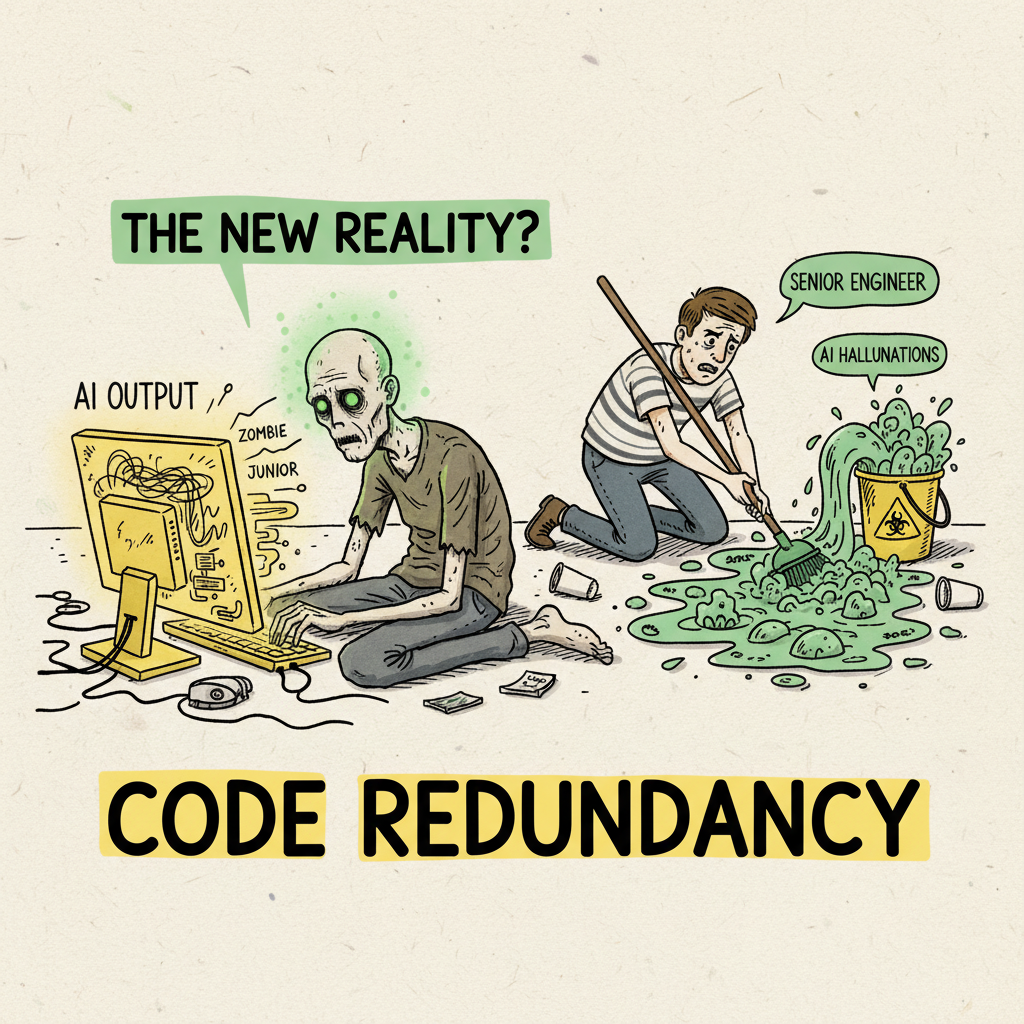
2. The “Zombie” Junior Developer
If you are a Junior today, I feel for you. You have a tool that can do your job better than you can. It’s tempting to lean on it.
But this creates the Deskilling Crisis.
It’s not about banging your head against a missing semicolon (that’s just friction). It’s about the Loss of Iterative Logic.
When you write code manually, you have to decompose a big problem into small parts. When you prompt, the AI swallows the whole problem at once. Juniors are skipping the “Decomposition Struggle,” which is how we learn to think like engineers.
When you use AI to bypass the struggle, you bypass the learning.
We are seeing the rise of the “Zombie Junior”—but let’s be clear: this isn’t a failure of the junior’s character. It’s a systemic failure of mentorship.
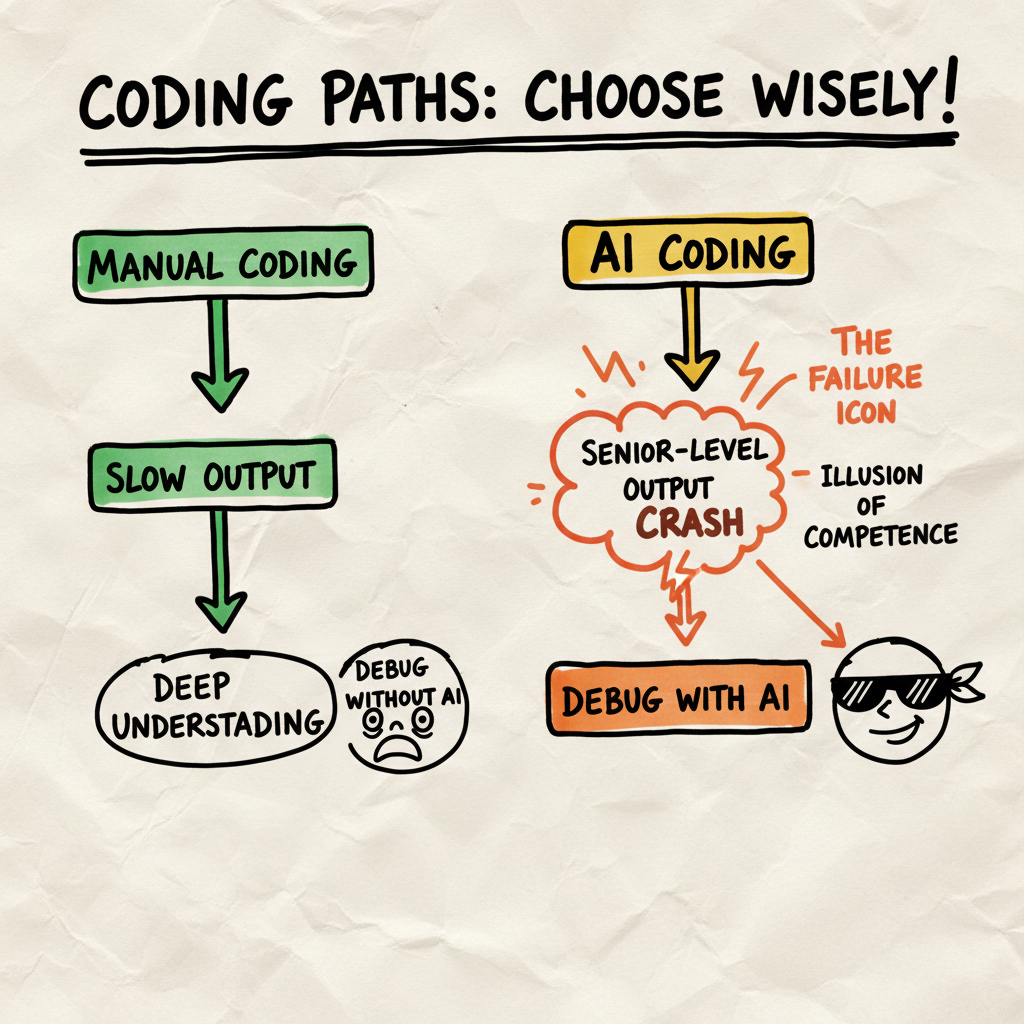
Juniors are victims of a tool that is too good for its own sake:
- They can generate a complex React component in seconds.
- They communicate like a Senior Engineer in PR descriptions.
- But: Because our mentorship processes haven’t caught up, they are skipping the “Desirable Difficulty” of learning patterns.
They are being denied the “Project Euler moments” that forge competency. We are creating a generation of engineers with Senior Output but Junior Understanding. They are building a career on a foundation of sand. As found in my MSc Thesis on Developer Productivity, this creates a “Double-Edged Tool of Agency”: the AI empowers them to build, but simultaneously erodes the struggle required for mastery, leading to profound “AI Impostor Syndrome.”
3. The Senior’s Burden (Janitorial Duty)
And who pays the price? The Seniors.
Senior Engineers are no longer mentors; they are Janitors.
They are drowning in Pull Requests that are statistically larger, more verbose, and more subtly buggy than ever before. Reviewing AI code is high-cognitive-load work (Verification Tax) with zero dopamine reward.
Instead of teaching a Junior how to think, the Senior is just spotting hallucinations in a wall of text generated by a robot. This breaks the social contract of mentorship. It leads to Review Fatigue and deep, cynical burnout.
☕ The Takeaway: Reclaiming Mentorship
We need to intervene. We need to protect our Juniors from the “easy path” that leads nowhere.
For Managers & Mentors:
- The “No-AI Gym”: Treat manual coding like fitness. Juniors should have “analog” weeks where they must code without AI assistants. It’s not about speed; it’s about building mental muscle.
- “Explain It To Me”: In code reviews, don’t just look at the code. Ask the Junior to explain the logic verbally. If they can’t explain it, they didn’t write it (even if they prompted it). Revert the PR.
- Pair Programming (Human-to-Human): Bring back pairing. Real pairing. Watch them type. Watch them think.
In Part 5, we’ll look at how to measure this mess. Because if you’re using standard DORA metrics, you’re flying blind.
🔬 The Hypothesis & The Request
This post proposes the following hypothesis:
Hypothesis: AI tools act as a “Super-Stimulus” that disproportionately affects neurodiverse developers, and fundamentally breaks the apprenticeship model by automating away the “Desirable Difficulty” required for learning.
Research Question I’d Love to See Answered:
Longitudinal career tracking. Do “AI-Native” juniors promote to Senior Engineer at the same rate as “Traditional” juniors? Or do they hit a “Complexity Ceiling” where their lack of deep mental models prevents them from architecting systems?
📚 Further Reading
- DORA Insights: How gen AI affects the value of development work. Explaining the paradox where developers feel more satisfied despite doing less valuable work.
- DORA Insights: Concerns beyond the accuracy of AI output. An investigation into deskilling and job displacement fears.
- The MIT Study: Your Brain on ChatGPT (MIT Media Lab). Providing physiological evidence of “brain idling” during AI usage.
- The Metacognitive Gap: “It’s Weird That it Knows What I Want” (Prather et al., ACM 2023). A study revealing how novices using Copilot experience an “illusion of competence,” generating code they cannot explain or debug.
- The Inhibitory Brake: ADHD symptoms and problematic digital media use in emerging adults (Todorovic et al., Addictive Behaviors). Exploring how deficits in inhibitory control link hyperactivity to problematic digital usage.